What’s in This Guide
- What Silversmithing Is (and How It Relates to Metalsmithing)
- What a Beginner Silversmithing Class Covers
- The Tools You Will Meet at the Bench
- How to Solder Jewelry: The Ideas Behind a Strong Seam
- How a First Ring Takes Shape
- Choosing Your Starting Point
- Frequently Asked Questions
- Start Your Silversmithing Practice at the Bench
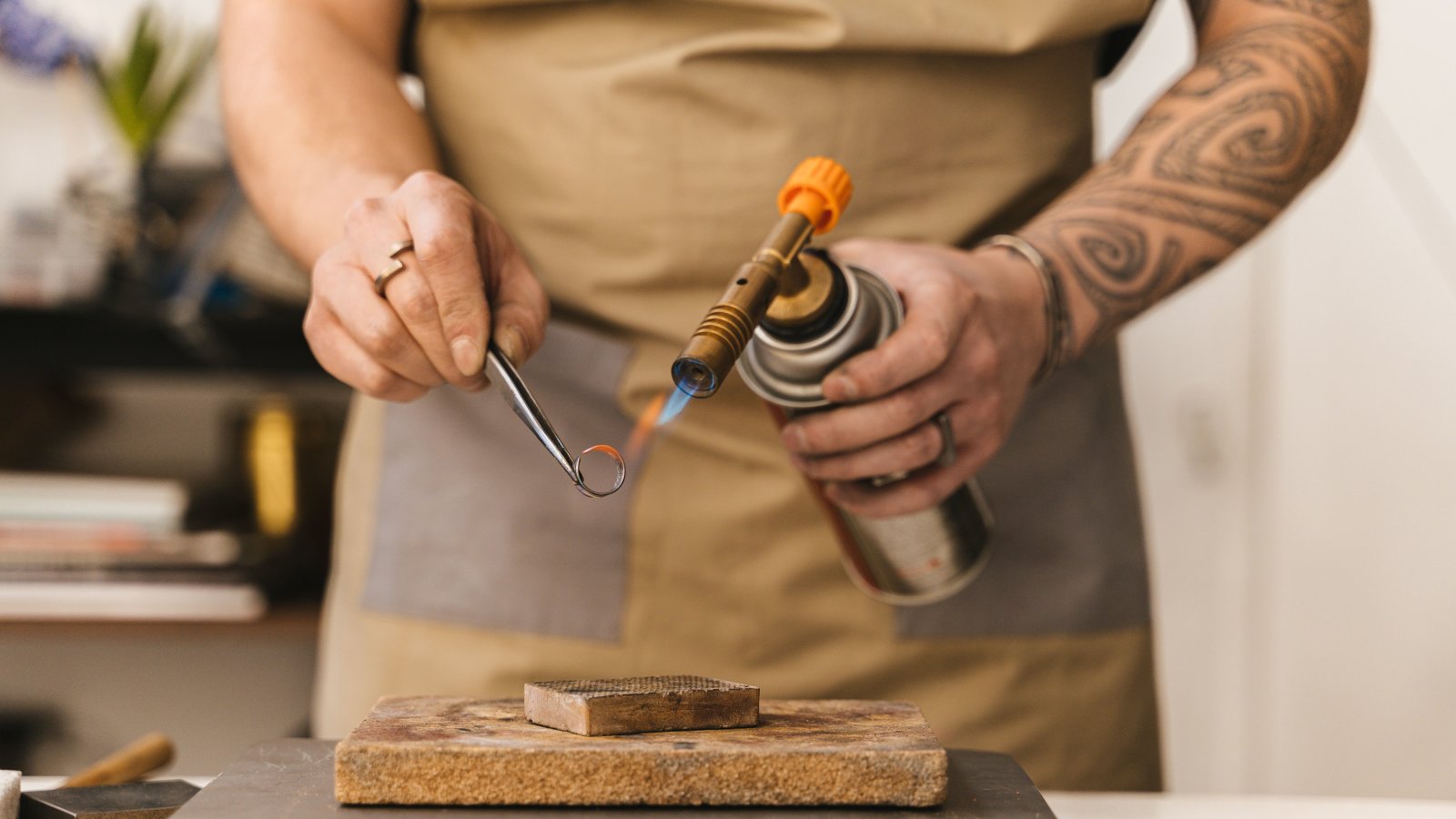
A flat strip of sterling silver does not look like much. Then a torch warms it, a seam closes, and the strip becomes a band that fits a finger. That small transformation is why silversmithing pulls so many first-timers back to the bench for a second class, then a third.
If you have wondered what actually happens in a beginner class, the answer is more approachable than the torch might suggest. Instructors start with safety, move through measuring, sawing, and filing, and build toward soldering, the skill that joins one piece of metal to another.
Key Takeaways
- Silversmithing is a branch of metalsmithing, the wider craft of shaping and joining metal into jewelry and objects.
- Beginner classes build skills in order: safety, measuring, sawing, filing, forming, soldering, and finishing.
- Soldering depends on three habits: clean metal, flux, and a tight seam heated evenly.
- Ring projects vary by course, so the current class listing is the most reliable guide to what you will make.
- Ventilation, eye protection, and instructor guidance are part of the craft from the first minute.
What Silversmithing Is (and How It Relates to Metalsmithing)
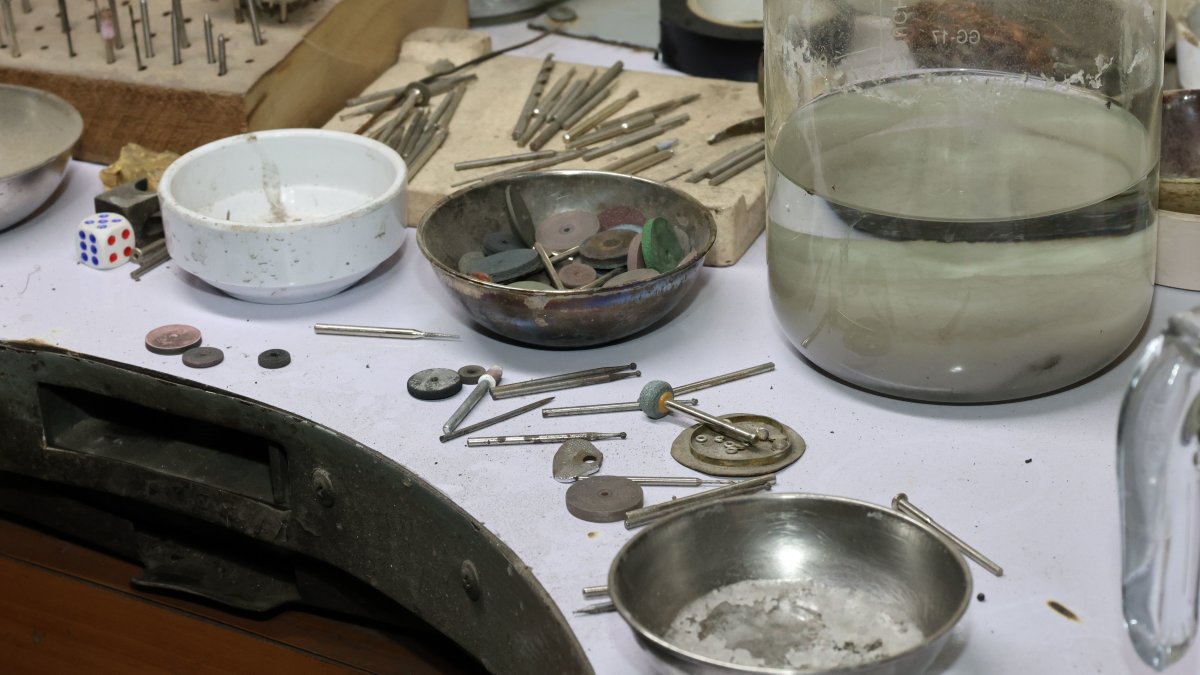
Silversmithing is the craft of making jewelry and small objects from silver by sawing, forming, soldering, and finishing the metal by hand. It sits under the larger umbrella of metalsmithing, which also includes working in copper, brass, gold, and other metals.
Someone typing “metalsmithing” and someone typing “silversmithing” into a search bar are usually after the same thing: a hands-on introduction to how metal behaves when it is heated, shaped, and polished.
Silver is a popular first metal because it saws cleanly, responds well to heat, and takes a bright polish. In the United States, the word “sterling” has a legal meaning. The Federal Trade Commission’s Jewelry Guides reserve it for metal that is at least 92.5 percent pure silver, and the remainder is usually copper, which adds the strength a ring needs for daily wear.
What a Beginner Silversmithing Class Covers
Every course description sets its own specifics, but beginner offerings tend to follow a logical order. A sampler workshop works as a low-commitment first taste, with a safety orientation, an introduction to basic tools, instructor demonstrations, and guided work on a small project.
Knowing how a class, workshop, and course differ makes those titles easier to compare.
Safety and Studio Habits
Before any metal gets cut or heated, students learn how the studio works: where equipment lives, how to handle tools, what to wear, and when to ask for help. Small classes keep you close to the instructor, which matters around torches, kilns, and machinery.
Measuring, Sawing, and Filing
Jewelry is precise work. A fraction of a millimeter decides whether two edges meet cleanly, so measuring comes before cutting. Students learn to cut metal with a jeweler’s saw, a thin blade held in a bow-shaped frame, and to refine edges with files until they fit.
Forming and Shaping
Metal can be bent, curved, and textured once it has been softened with heat. Beginners practice shaping flat stock into rounded forms, which prepares them for rings, pendants, and bands.
Soldering
Soldering is the centerpiece of most beginner courses, because nearly every piece of jewelry has a joint that needs to hold. It gets a section of its own below.
Finishing
Filing, sanding, and polishing turn a rough construction into a finished piece. This is where students see how much of jewelry quality lives in the details nobody photographs.
The Tools You Will Meet at the Bench
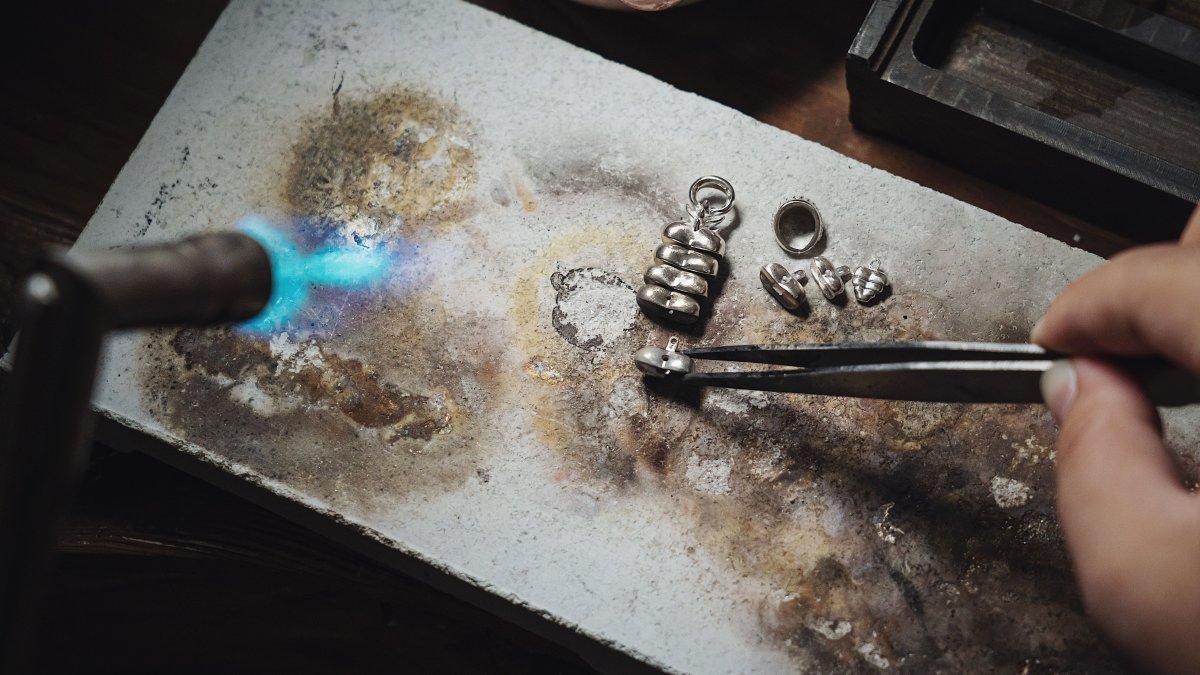
A silversmithing studio can look crowded with equipment at first glance. Most of it falls into a few families.
|
Tool |
What it does |
|
Jeweler’s saw |
Cuts sheet and wire with fine, controlled lines |
|
Files and sandpaper |
Smooth edges and bring seams flush |
|
Torch |
Supplies the heat for softening metal and flowing solder |
|
Flux and solder |
Flux protects the joint from oxidation; solder is the filler alloy that joins the pieces |
|
Pickle |
A mild acid bath that cleans away oxides and flux after heating |
|
Mandrel and mallet |
Round and size a band without marring the metal |
|
Flex shaft and buffing wheels |
Power tools for sanding, polishing, and detail work |
How to Solder Jewelry: The Ideas Behind a Strong Seam
Soldering joins metal with a filler alloy that melts at a lower temperature than the pieces being joined. The seam fills while the piece itself stays solid. Silver solder is commonly sold in hard, medium, and easy grades, named for how readily they melt, which lets a maker build a piece in stages without undoing earlier joints.
Three habits separate a strong seam from a failed one:
- Start with clean metal. Oils, fingerprints, and oxides keep solder from flowing.
- Use flux. It coats the joint and shields it from oxidation while it heats.
- Fit the seam tightly. Solder fills a hairline gap beautifully and a wide gap poorly.
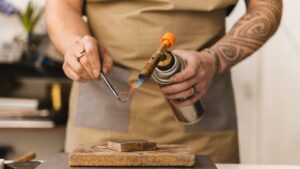
Heat management matters just as much. Solder follows heat, so the skill lies in warming the piece evenly and letting the metal draw the solder into the joint, rather than chasing it with the flame. Anyone curious about other torch-based crafts can compare glass blowing versus flameworking and how they differ.
After soldering, the piece goes into pickle to remove residue before filing and finishing.
Videos can show a flame, but they cannot show you the moment a seam is ready or let someone correct your angle in real time. That is where in-person instruction earns its place.
Fumes, Flame, and Eye Protection
Working with a torch calls for respect, and the research agrees. NIOSH materials on brazing note that cadmium in some silver filler alloys can vaporize when overheated, and that fluxes can release fluoride fumes when heated, which is why ventilation and careful solder selection matter to anyone working with a torch.
Federal workplace rules such as OSHA’s personal protective equipment standard rest on a simple principle: assess the hazard first, then match the protection to it.
Beginners see that principle in everyday studio habits: safety glasses when directed, long hair tied back, loose clothing secured, and no unfamiliar equipment started without instructor approval. This information is educational background only. Studio rules and the instructor’s directions always come first.
How a First Ring Takes Shape
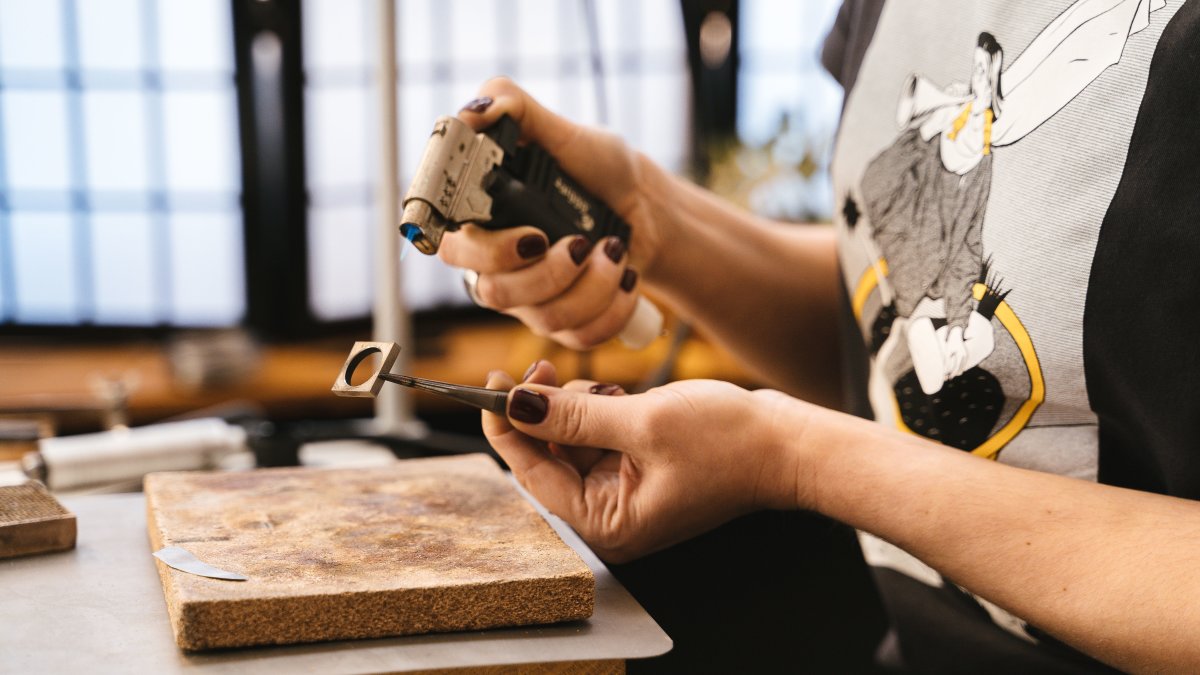
Projects differ by course, and not every introductory class builds a ring. When a ring is the project, the process generally follows a familiar path:
- Measure. Finger size and band width determine how much metal is needed.
- Cut. A strip of sheet metal or wire is sawn to length.
- Soften and bend. Heating the metal (annealing) makes it flexible enough to form into a loop without cracking.
- Close the seam. The two ends are filed until they meet without a gap.
- Solder. Flux, even heat, and a small piece of solder join the ends into a continuous band.
- Pickle and rinse. The acid bath clears away oxides and flux.
- Round and size. The band is shaped over a mandrel until it is true.
- File, sand, and polish. Each pass refines the surface toward a bright finish.
It is an overview, not a recipe. Instructors teach the exact methods, temperatures, and timing in the studio, where mistakes become part of the lesson. Anyone hoping for a ring making class should read each listing closely, since the finished project depends on the course.
Choosing Your Starting Point
The right first class depends less on creativity than on how much studio time you have already logged.
- New to jewelry making: A Sampler Workshop or Silversmithing 101 introduces basic tools, safety practices, and simple construction.
- Ready for more independence: Silversmithing 102 and fabrication classes leave room for your own design decisions and steadier practice with soldering, forming, and finishing. Seeing how a class differs from open studio time helps you decide when to practice solo.
- Comfortable with the basics: Technique-focused workshops in metal clay, enameling, and wax modeling assume confidence with soldering and kiln work.
Before registering, check each listing for age requirements, prerequisites, course length, materials fees, and space availability. Some silversmithing classes set age minimums, so younger crafters may prefer pottery classes designed for children and families.
Frequently Asked Questions
Do you need artistic skills to start silversmithing?
No. Patience and steady hands matter more than drawing talent. Simple designs let beginners build confidence with the basic techniques before moving on to more detailed work.
How long does it take to learn how to solder jewelry?
Most beginners grasp the basic steps quickly, but consistency comes with repetition. Even heating and clean seam fits improve with each attempt, so extra practice makes a noticeable difference.
Does sterling silver tarnish, and how do you care for it?
Yes, tarnish is normal. Silver reacts with sulfur compounds in the air, which gradually darkens the surface. A soft polishing cloth and dry storage keep handmade pieces looking bright.
What is the difference between sterling silver and fine silver?
Fine silver is about 99.9 percent pure and noticeably softer. Sterling silver is alloyed with other metals, usually copper, which makes it harder and better suited to everyday wear.
How is handmade jewelry different from cast jewelry?
Handmade pieces are built by sawing, forming, and soldering sheet and wire. Cast pieces start as a wax model and are formed by pouring molten metal into a mold. Both fall under metalsmithing, and many makers use the two methods together.
Start Your Silversmithing Practice at the Bench
At Brookfield Craft Center, we teach silversmithing in a historic, hands-on studio where small classes, working artists, and experienced instructors help beginners build real skill at their own pace. A class can also double as one of the craft experience gifts for the makers on your list.
Explore our current jewelry classes to compare experience levels, find a start date, and register for the workshop that fits your goals.
Related Posts